

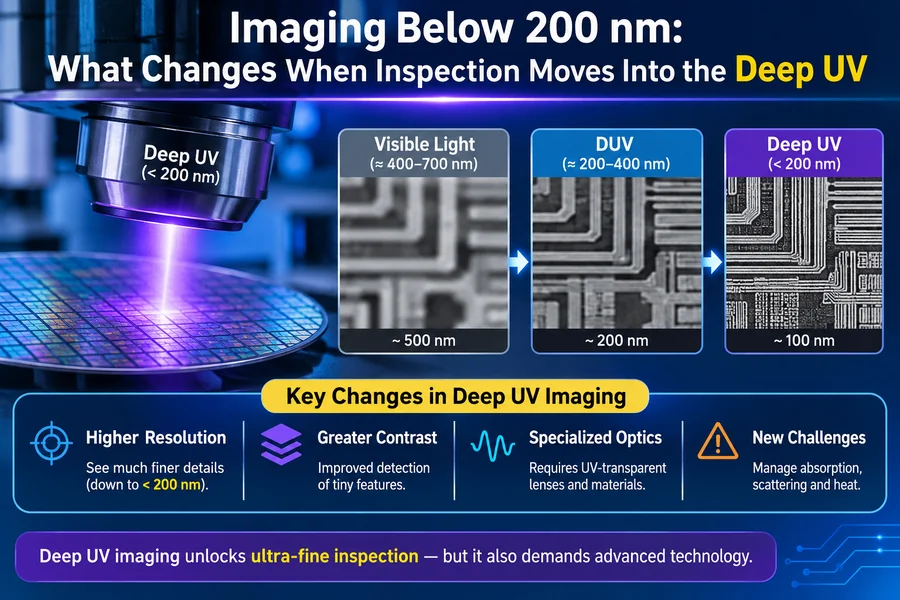
Somewhere between 266 nm and 193 nm, an inspection system stops being an optical instrument with an unusual light source and becomes an environmental engineering project with an optical payload. The change is not gradual. It arrives with the realisation that the illumination is being absorbed by the air it travels through, that the sensor is barely responding to the photons it receives, and that the sample itself may be altered by the measurement.
Deep-UV inspection is nonetheless indispensable. The 193 nm ArF excimer line that patterns advanced nodes is also one of the few practical ways to review the masks and resist patterns those nodes depend on, and the physics that makes it useful for lithography makes it useful for inspection: high photon energy, very short wavelength, and strong interaction with polymer films.
The Atmosphere Becomes Part of the Optical Design
At 193 nm, oxygen and water vapour absorb strongly. A path length that is entirely comfortable at 365 nm becomes a serious loss at 193 nm, and the loss is not constant: it tracks humidity, temperature, and purge quality. Systems therefore operate with nitrogen purging or under vacuum, and the optical path is designed to be as short as the application allows.
This changes the camera’s role. A camera that sits inside a purged enclosure must tolerate the enclosure’s atmosphere, its thermal environment, and its service access constraints. Windows must transmit at the working wavelength, sealing must not outgas, and connectors must survive whatever cleaning protocol the tool uses. Specifications written for a bench-mounted camera rarely survive this translation without modification.
Silicon Stops Cooperating
Front-illuminated silicon sensors have a thin, heavily doped surface region where UV photons are absorbed before they can be collected. At 193 nm, absorption is so shallow that a conventional sensor may convert only a small percentage of incident photons into signal. Back-illuminated devices remove that dead layer by thinning the substrate and illuminating the collection side directly, and with dedicated anti-reflection coatings they recover a usable quantum efficiency.
Even then, the numbers are modest compared with the visible band, which means noise becomes the dominant design constraint. A 30% quantum efficiency sensor with 2 electrons of read noise will outperform a 45% sensor with 10 electrons of read noise on any exposure short enough for production. This inversion of the usual ordering is one of the reasons deep-UV camera selection is so often done badly: teams apply visible-band intuition to a band where it does not hold.
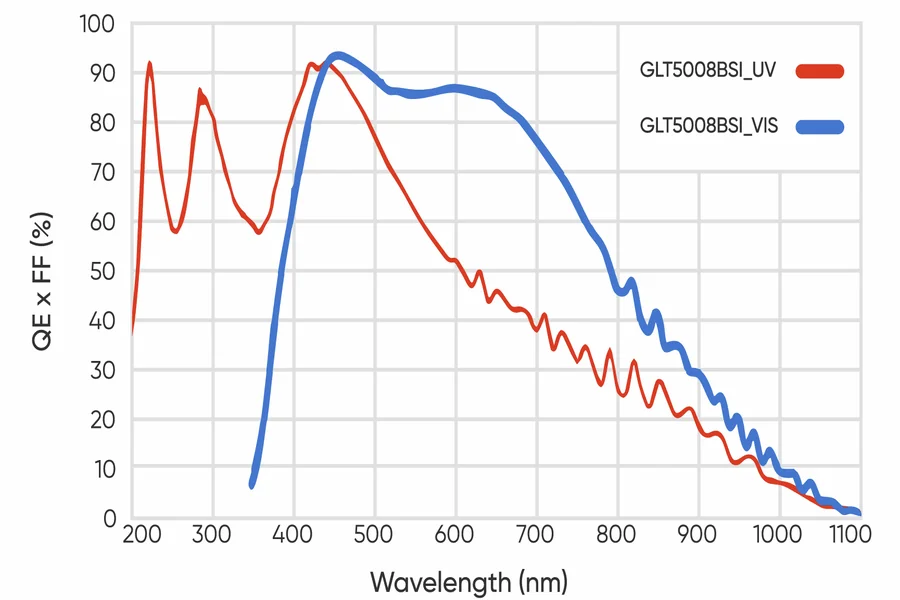
Figure 1: Quantum efficiency across the UV and visible range, showing how rapidly response falls below 300 nm.
Cooling Is No Longer a Comfort Feature
Because signal per photon is low and exposures in review applications can be long, dark current becomes a first-order term rather than a correction. Deep cooling is required not to reach an impressive temperature but to hold a stable one: the useful property is repeatability between calibration and measurement, across hours and across power cycles.
The Mask and Resist Case
The most demanding deep-UV inspection tasks involve photomasks and patterned resist. Both are low-contrast subjects by nature: a phase-shift mask is designed to produce almost no intensity variation in the bright field, and a resist pattern on an anti-reflection layer can be nearly invisible under visible light. At 193 nm, the interaction with the film stack produces contrast that simply does not exist at longer wavelengths, which is why the band remains in use despite its operational cost.
The camera requirement in these applications is less about raw speed than about stability and uniformity. A mask review tool may take many exposures at different focus positions, and the comparison between them is only meaningful if the sensor’s response does not change between frames. Pixel-level correction of DSNU and PRNU, combined with tight thermal control, is what makes that comparison valid.
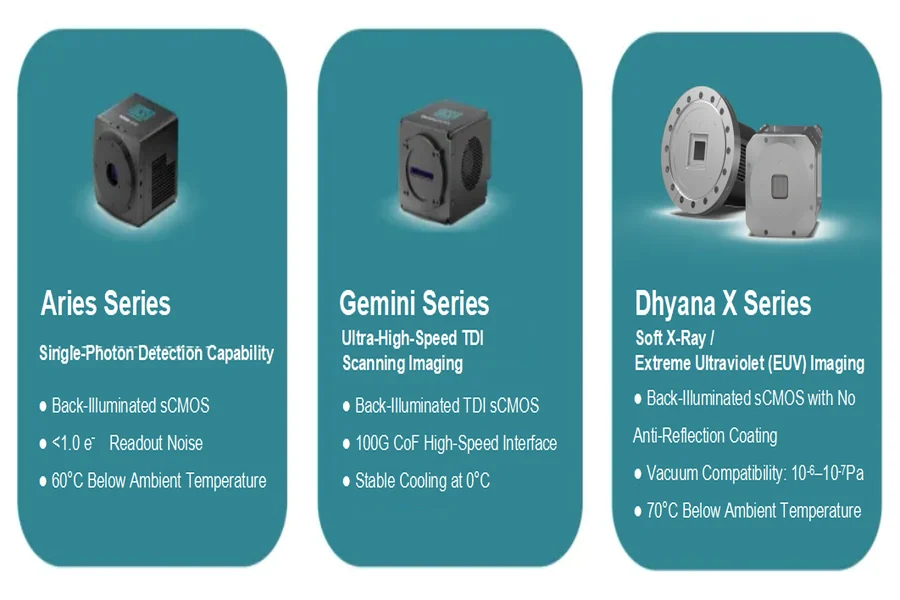
Figure 2: Camera classes suited to DUV and EUV inspection tasks.
What About EUV and Soft X-Ray?
Above roughly 100 eV, photon energy is high enough that the interaction mechanism changes again. Instead of exciting electrons across a bandgap, photons ionise core levels, and the detector must survive radiation that degrades conventional devices. Back-thinned sensors with radiation-tolerant design, vacuum compatibility in the 10⁻⁶ to 10⁻⁷ Pa range, and deep cooling are the standard configuration. The measurement itself usually requires vacuum, and the sample is often a packaged device whose internal structure is what the inspection is trying to see.
Choosing between a deep-UV camera and an X-ray or EUV camera is therefore not a matter of preference. It is determined by whether the defect of interest lives on the surface or inside the stack. A EUV camera for various inspection configuration extends the same imaging philosophy, back-illuminated detection with heavy cooling, into a band where the optical path is no longer glass at all.
Practical Guidance
For teams building a multi-band strategy, it helps to treat each band as a separate instrument with its own constraints rather than as a single camera requirement. A structured approach to Choosing the Right UV Camera for Semiconductor Inspection across UVA, UVC, DUV, and EUV prevents the common failure mode in which one band’s assumptions are carried into another.
Conclusion
Deep-UV inspection rewards teams who accept that the environment is part of the optics and that the sensor is the weakest link in the chain. Below 200 nm, every design decision becomes coupled: the purge affects the signal, the signal affects the exposure, the exposure affects the cooling requirement, and the cooling requirement affects the mechanical envelope. Cameras engineered for that reality, rather than adapted to it, are what make the band practical for production rather than only for the laboratory.
